


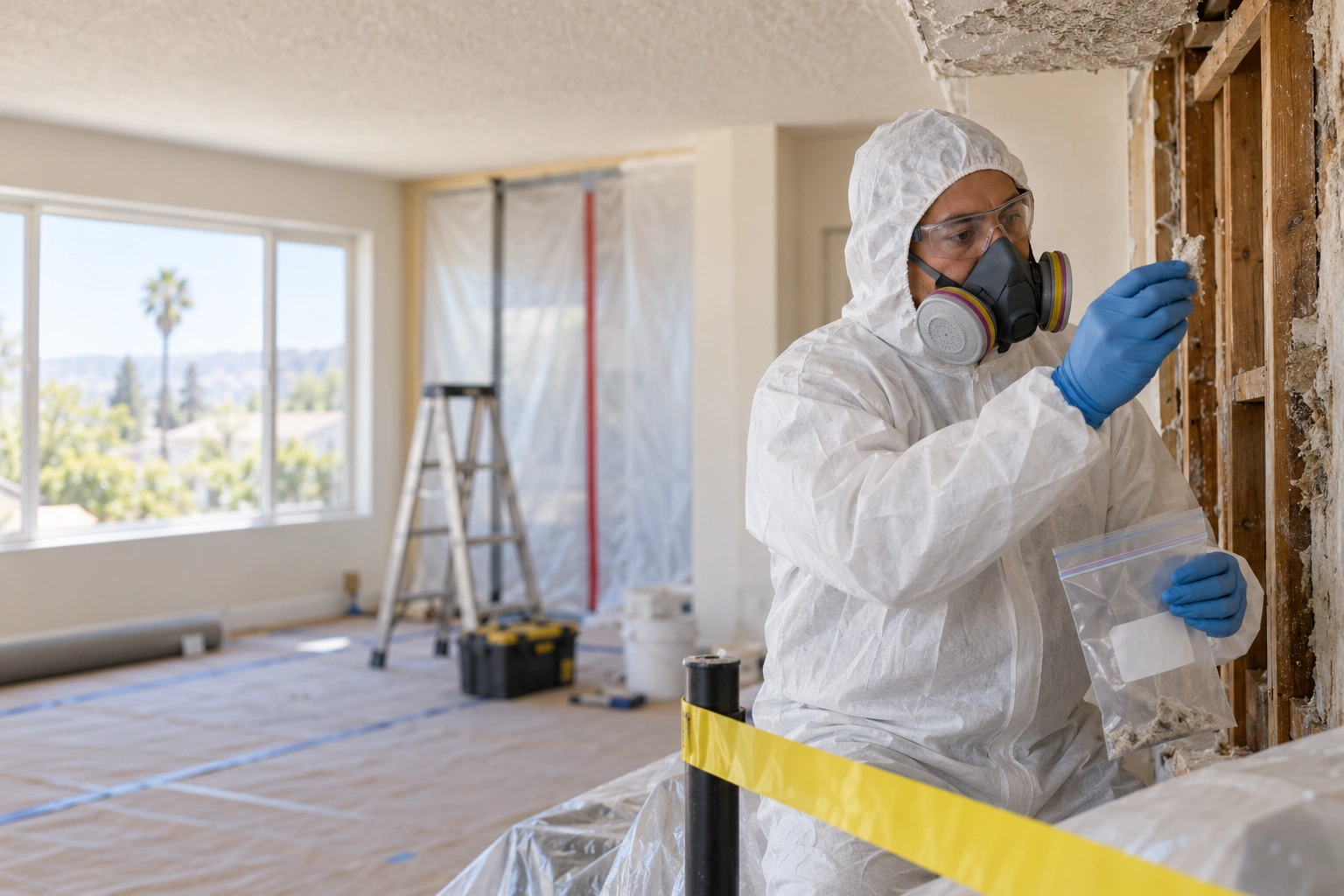
When demolition exposes suspicious material, asbestos found during remodel California can interrupt a kitchen, bathroom, or whole-home project without warning. Do not let the crew keep cutting, sanding, sweeping, or removing material in that area. Instead, pause the affected work, protect the space from foot traffic, and arrange qualified testing before you approve the next phase.
For Ontario and Inland Empire homeowners, a short, organized pause now can prevent a larger cleanup, a confusing change order, and damage to new work later.
What Should You Do When You Find Suspected Asbestos?
When you discover a suspicious material during demolition, take four practical actions:
- Stop work in the affected area immediately.
- Keep children, pets, and unnecessary traffic away from the work zone.
- Photograph the location and note what demolition exposed it.
- Hire a qualified asbestos professional to arrange sampling, analysis, and the right next step.
The EPA explains that demolition, repair, and remodeling can release asbestos fibers when workers disturb asbestos-containing materials. Read the EPA’s asbestos guidance before anyone resumes work.
Asbestos Found During Remodel California – First Steps
Asbestos found during remodel California does not automatically mean the entire property has a contamination problem. However, it does mean that nobody should make decisions based on appearance alone. Old materials can look harmless, while some newer-looking repairs may cover older building products.
A qualified evaluation gives the homeowner, abatement professional, and remodeling contractor one reliable set of facts. That process helps everyone decide whether the material needs removal, enclosure, another treatment method, or no action beyond protecting an undisturbed area.
The California Contractors State License Board advises homeowners to avoid disturbing suspected material and to use proper testing to confirm asbestos. Its consumer guide to asbestos also explains why visual guesses do not replace laboratory analysis.
Stop the Affected Work, Not Necessarily the Entire Project
Pause demolition in the location where the crew uncovered the material. Do not ask workers to “finish that wall” or clean the debris before testing. Avoid ordinary vacuums, dry sweeping, drilling, sanding, and breaking material into smaller pieces.
A qualified professional can determine whether unaffected work can continue. For example, a contractor may continue exterior work while a specialist reviews a contained bathroom wall. The project team should make that decision only after reviewing the layout, material location, and level of disturbance.
Document the Discovery Without Touching It
Take photos from a safe distance. Record the room, wall, ceiling, floor, or mechanical area involved. Note what work uncovered the material and whether anyone moved debris into another room.
Do not collect a sample yourself. Let the qualified professional explain the testing method, laboratory process, expected turnaround, and the next construction steps. This approach protects your household and creates a clear project record.
Why Older Remodeling Projects Need a Pre-Demo Review
Many Ontario homes have gone through decades of repairs, additions, flooring changes, and bathroom updates. A remodeling crew may uncover old floor backing, textured finishes, pipe insulation, duct materials, adhesives, or hidden wall layers after demolition starts.
A pre-demo review cannot eliminate every surprise. It can, however, identify likely risk areas before crews open walls or remove flooring. Homeowners planning kitchen remodeling should consider this step when the scope includes old flooring, soffits, wall finishes, or mechanical components.
The same principle applies to bathroom remodeling. Bathrooms often combine demolition, plumbing, tile removal, drywall replacement, ventilation work, and waterproofing. A clear review before demolition helps the team avoid rebuilding over an unresolved issue.
What California Homeowners Need to Check
California treats asbestos work as a specialized area. The required process depends on the material, its condition, the amount involved, the project location, and the planned work. Do not rely on a contractor who says that a small amount makes the issue harmless or informal.
The CSLB identifies C-22 Asbestos Abatement as a specialty classification. A residential remodeling contractor must hold the appropriate classification or work with an appropriately licensed specialist when the scope includes asbestos abatement. Homeowners should verify current licensing, insurance, abatement credentials, and Cal/OSHA registration before approving the work.
Ontario homeowners should also check project-related permit requirements through the City of Ontario Building Division. Building permits and asbestos requirements can affect the same remodel, but they do not serve the same purpose.
| Situation | Best next step | Who should handle it? | Effect on the remodel |
|---|---|---|---|
| Suspected material, no testing | Pause the affected work and arrange sampling | Qualified inspector or consultant | Short, controlled pause |
| Confirmed small, accessible area | Obtain a written abatement scope | Properly qualified specialist | Targeted change to schedule |
| Material behind multiple finishes | Define the full affected area first | Consultant and abatement contractor | May change budget and sequence |
| Widely disturbed or friable material | Follow a containment and clearance plan | Licensed abatement team | Larger pause and detailed documentation |
Asbestos Found During Remodel California – Cost and Schedule Impact
When asbestos found during remodel California affects a project, homeowners need to separate two budgets: the specialized evaluation and abatement work, and the reconstruction that follows.
As of September 2026, an Ontario homeowner may use these planning ranges when discussing a mid-demo discovery:
| Scope | Planning range | Main cost drivers |
|---|---|---|
| Small, accessible contained area | $3,000–$6,000 | Testing, setup, access, disposal |
| Multiple surfaces or an occupied-room renovation | $6,000–$12,000 | Containment, damaged materials, clearance, repairs |
| Larger or difficult-access discovery | $12,000–$18,000+ | Multiple rooms, extensive removal, disposal, reconstruction |
These figures support early planning only. They do not replace a written local quote. Material type, square footage, access, the condition of the material, containment requirements, disposal, and finish repairs all change the final amount.
A current national guide places typical professional indoor abatement lower for many limited scopes but also shows how complex access, demolition, repairs, and larger areas raise costs. Review the 2026 asbestos cost factors.
Ask every bidder to separate these line items:
- Testing and laboratory analysis
- Containment and worker protection
- Removal, enclosure, or other approved treatment
- Waste handling and disposal
- Clearance or final documentation
- Drywall, tile, flooring, paint, plumbing, or electrical reconstruction
That detail helps you compare bids fairly and prevents a vague “hazardous-material allowance” from becoming an open-ended change order.
How to Restart the Project Without Creating Rework
Do not restart demolition or install new finishes until the project team completes the required specialist work and documents the next phase. A rushed restart can force the contractor to remove fresh drywall, flooring, cabinetry, or tile later.
Before you authorize reconstruction, confirm the following:
- The laboratory result and specialist scope match the exact area uncovered.
- The abatement contractor has current credentials and proper insurance.
- The contract identifies who handles containment, disposal, and required records.
- The project manager has updated the construction sequence.
- The team has revised the budget and timeline in writing.
- Material deliveries and trade appointments now match the new schedule.
- The project file includes reports, invoices, change orders, and clearance records.
Homeowners should not choose the lowest asbestos bid automatically. The CSLB recommends comparing qualified contractors, checking references, reviewing the work plan, and asking for clear documentation.
Common Mistakes After an Asbestos Discovery
The most expensive decision often comes from trying to avoid a short pause.
Do not treat a visual opinion as a lab result. Do not let workers sweep or vacuum questionable debris with standard equipment. Do not approve a verbal price with no defined scope. Do not install new finishes before the project team resolves the affected area.
Another common mistake involves insurance. Homeowners should not assume that a policy covers testing, abatement, damage, or reconstruction. Coverage depends on the policy language, exclusions, cause of loss, and the insurer’s decision. Contact the carrier directly when you believe a claim may apply, and keep all reports and invoices.
How WM Construction Helps After a Mid-Demo Discovery
WM Construction has served Ontario, Rancho Cucamonga, and nearby Inland Empire communities since 2014 as a licensed residential remodeling contractor, CSLB Lic. #1104199.
When a project uncovers a suspected material, WM Construction can review how it affects the remodeling scope, help coordinate the construction sequence after qualified asbestos work, and update the reconstruction plan around actual site conditions. The goal is not to rush through uncertainty. The goal is to protect the home, budget, design, and finish schedule.
Once the team resolves the affected area, WM Construction can coordinate the next steps for drywall, tile, flooring, cabinetry, fixtures, paint, or other work. Its remodeling services support homeowners planning kitchens, bathrooms, flooring upgrades, home additions, and ADUs.
Frequently Asked Questions
Does asbestos found during remodel California mean my entire home is unsafe?
No. The risk depends on whether the material contains asbestos and whether demolition damaged or disturbed it. Stop work in the affected area and arrange qualified testing. A professional can then define the actual scope instead of treating the whole home as a contamination zone.
Should I stop demolition if I find suspected asbestos?
Yes. Stop work in the affected location until a qualified professional evaluates the material. Do not sand, drill, sweep, vacuum, or remove it. Other work may continue only if the project layout and the specialist’s guidance support that decision.
How do I confirm whether the material contains asbestos?
A qualified professional collects or arranges the appropriate sample and sends it to a laboratory for analysis. Do not rely on a visual guess or a contractor’s informal opinion. The lab result gives the project team a sound basis for abatement and reconstruction decisions.
How much does asbestos found during remodel California cost to address?
Asbestos found during remodel California can add roughly $3,000 for a small, accessible scope and $18,000 or more for larger or complex conditions. The final cost depends on testing, containment, removal method, disposal, clearance, access, and reconstruction after abatement.
Will homeowner’s insurance cover asbestos discovered during renovation?
Your policy controls coverage. Insurance companies consider the cause of loss, exclusions, policy terms, and the facts of the claim. Contact your insurer directly before you make assumptions about payment, and keep copies of reports, invoices, photos, and written scopes.
Can WM Construction help if asbestos changes my remodel plan?
Yes. WM Construction can review how the discovery changes the remodeling scope, schedule the reconstruction phase after qualified specialist work, and update the project sequence. Confirm the specific abatement scope, contractor arrangement, timeline, and pricing during your consultation.
Schedule a Post-Demo Assessment
If asbestos found during remodel California has interrupted your home project, schedule a post-demo assessment with WM Construction. Call 951-310-3458 to discuss how the discovery affects your kitchen, bathroom, flooring, addition, ADU, or whole-home remodel in Ontario, Rancho Cucamonga, or the surrounding Inland Empire.