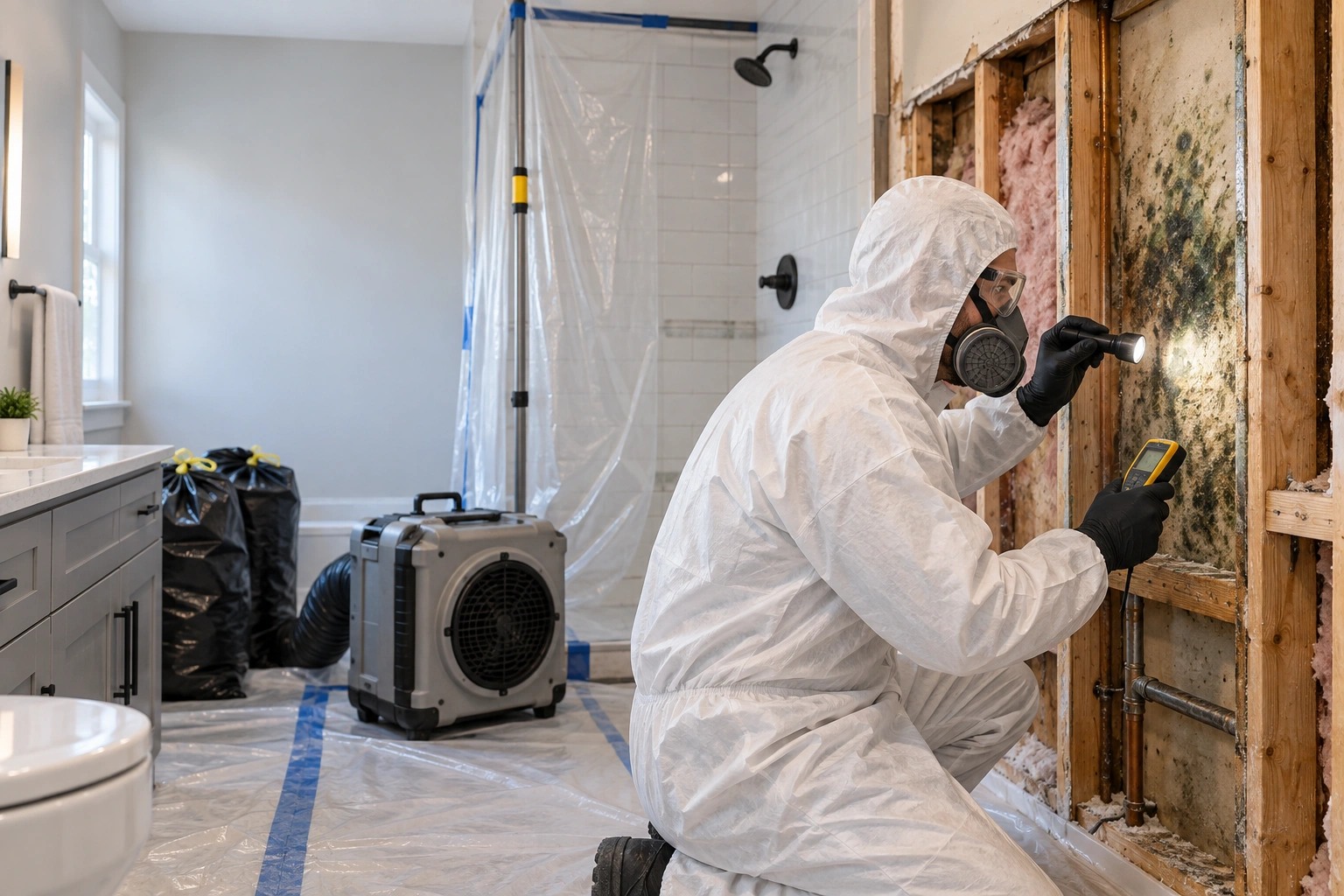
Finding dark mold growth after removing a vanity, shower surround, or drywall can stop a bathroom remodel in its tracks. The immediate temptation is to spray it, cover it, and keep the project moving. That approach can leave the moisture source untouched and allow the problem to return behind new finishes.
A mold behind bathroom wall remodel needs a measured response. First identify and stop the moisture. Then determine the affected materials, choose the right cleanup or remediation scope, and rebuild only after the area is dry and ready for finishes.
Mold needs moisture to grow. The EPA advises homeowners to clean up mold promptly and fix the water problem, rather than treating mold as only a surface-stain issue.
Mold Behind Bathroom Wall Remodel First Steps
Do not rush to install new drywall, backer board, or tile. Take these practical steps first.
- Stop the water source if possible. A leaking supply line, drain, shower valve, failed shower pan, or plumbing connection can keep feeding the problem.
- Photograph the visible conditions before demolition continues. Record staining, damaged framing, wet insulation, pipe locations, and the extent of removed finishes.
- Limit disturbance. Do not aggressively tear into a large hidden area without a plan for containment, cleanup, and disposal.
- Check how far moisture traveled. A visible patch may extend behind drywall, under flooring, around a tub, or into an adjacent wall.
- Separate the trades. A qualified plumbing professional should correct a plumbing failure. A mold remediation specialist should advise on cleanup when the scope warrants it. The remodeling team should rebuild after the area is dry and approved for finish work.
A good mold behind bathroom wall remodel focuses on the source first. New tile cannot solve an active leak, poor ventilation, or failed waterproofing behind the wall.
Black Does Not Identify a Mold Type
“Black mold” describes appearance, not a reliable diagnosis. Mold can appear in many colors, and color alone does not tell a homeowner how serious the material condition is or what species is present.
The CDC explains that you do not need to know the type of mold to take action. If you see or smell mold, remove it safely and correct the moisture problem. The CDC also does not recommend routine mold testing for most homes because there are no established standards for acceptable indoor mold levels.
Do not let a contractor use scary language instead of giving you a clear scope. Ask these questions instead:
- What caused the moisture?
- Which materials are wet or mold-damaged?
- How large is the affected area?
- Does the work need containment or specialized remediation?
- What needs removal, cleaning, drying, or replacement?
- How will the team confirm the moisture issue is fixed before rebuild?
What Causes Hidden Mold Behind a Bathroom Wall
Ontario and Inland Empire homes can develop hidden bathroom mold even when the room looks clean from the outside. A dry regional climate does not protect a wall cavity from a localized plumbing leak or repeated shower moisture.
Slow Plumbing Leaks
A small leak at a shower valve, supply connection, drain, or tub overflow can wet drywall and framing over time. Homeowners may first notice a musty odor, soft baseboard, peeling paint, loose tile, or staining on the opposite side of the wall.
Failed Shower Waterproofing
Tile and grout are finish surfaces. They do not replace a properly built waterproofing system behind the shower. When water gets past damaged grout, failed caulk, cracked tile, or an improperly detailed shower assembly, the wall can remain wet long after the shower dries.
Inadequate Bathroom Ventilation
A bathroom fan that does not exhaust effectively, or a bathroom without regular ventilation, can allow moisture to linger. The EPA recommends running a bathroom fan or opening a window during showering to reduce moisture. Its mold guidance also advises drying wet materials promptly and controlling humidity.
An Older Repair That Hid the Evidence
Paint, caulk, a new vanity, or a patch of drywall can cover visual clues without correcting the cause. This is why a partial cosmetic renovation can reveal conditions that were not visible before demolition.
When a Mold Behind Bathroom Wall Remodel Needs Professional Help
Small, isolated surface mold on a non-porous bathroom surface is different from hidden growth inside a wall cavity. The EPA uses roughly 10 square feet as a practical threshold for many homeowner cleanup decisions. Larger areas, major water damage, sewage contamination, HVAC involvement, or health concerns call for experienced professional guidance.
| Condition | Better next step |
|---|---|
| Small visible area on a hard surface with no leak history | Clean safely, dry the area, and correct the moisture source |
| Moldy drywall, insulation, carpet, or other porous material | Evaluate removal and replacement because porous materials can be difficult to clean completely |
| Hidden mold behind a shower, tub, or wall | Pause finish work and assess the source, extent, and proper cleanup sequence |
| More than about 10 square feet of growth or substantial water damage | Consult an experienced mold remediation professional |
| Damage caused by sewage or contaminated water | Use a professional with contaminated-water cleanup experience |
| Occupant health concerns or respiratory symptoms | Seek appropriate medical advice before participating in cleanup |
The EPA notes that porous materials may need disposal when mold affects them, and it specifically warns against painting or caulking over moldy surfaces. That only hides the condition and can lead to peeling or recurring growth later. See EPA cleanup guidance.
At this stage, a mold behind bathroom wall remodel should have a written scope that identifies the moisture source, removal area, drying approach, and reconstruction plan.
Hidden Mold Discovery California Rules and Permit Questions
Reddit advice often treats every mold discovery as either a simple DIY cleaning job or a legal emergency. Neither assumption helps an Ontario homeowner make the right project decision.
For an owner-occupied bathroom, the correct requirements depend on the construction scope. Plumbing relocation, wall changes, electrical work, ventilation changes, and structural repairs can trigger permit and inspection requirements even though the discovery began as a mold issue.
The City of Ontario explains that permit-required construction is subject to inspection and lists plumbing, electrical, ventilation, framing, and other building work among common inspection items. Review Ontario’s permit FAQs before finalizing the repair scope.
Ask your contractor to clarify in writing:
- Which repairs require permits
- Who pulls the permits
- Who handles plumbing, electrical, or ventilation corrections
- When inspections occur before walls close
- What documentation confirms the leak or moisture issue was corrected
- Who restores drywall, waterproofing, tile, paint, and cabinetry
Do not rely on a statement that the wall “looks dry now.” The project needs a clear cause-and-correction record before new finishes conceal the area.
Bathroom Mold Remediation Cost and What a Quote Should Include
Bathroom mold remediation cost depends on the size of the affected area, the material involved, accessibility, containment needs, the moisture source, and the amount of reconstruction required afterward.
A 2026 national consumer cost guide from This Old House places professional mold remediation broadly around $1,200 to $3,750. That figure should serve only as a starting point. A concealed bathroom discovery can cost more when the work also requires plumbing repair, demolition, drying, shower waterproofing, tile replacement, cabinetry work, and paint restoration.
Compare quotes by scope, not by the bottom-line number alone.
| Quote item | Why it matters |
|---|---|
| Moisture-source diagnosis | Prevents rebuilding over an active leak or water-intrusion path |
| Containment and protection | Helps limit dust and material spread during removal |
| Removal of affected porous materials | Defines what drywall, insulation, flooring, or backing material comes out |
| Drying and verification | Shows how the team will address wet materials before rebuild |
| Plumbing and ventilation correction | Fixes the cause rather than only the visible result |
| Reconstruction allowance | Clarifies drywall, waterproofing, tile, fixtures, cabinetry, and paint responsibilities |
| Permit and inspection responsibility | Avoids surprises once the project moves into repair work |
Do not compare a cleanup-only quote with a complete bathroom-rebuild quote. They cover different work. For a mold behind bathroom wall remodel, request an itemized scope that separates remediation, cause repair, and finish restoration.
Why a Partial Bathroom Remodel Can Miss Hidden Mold
A partial remodel can improve the visible room while leaving older conditions untouched behind adjacent walls. For example, replacing a vanity and floor may not expose the shower valve wall, tub surround, old supply lines, or damaged waterproofing.
A fuller bathroom remodeling scope gives the project team an opportunity to inspect wet-wall conditions before new finishes go in. That does not mean every bathroom needs a full renovation. It means the planned scope should match the actual condition behind the finishes.
Mold during renovation in the Inland Empire often becomes expensive when a homeowner selects finishes before confirming what the wall needs. If the project already includes a new shower, plumbing changes, or layout work, it is usually wiser to resolve hidden moisture questions before ordering tile and cabinetry.
The Correct Sequence After Mold Is Found
A successful mold behind bathroom wall remodel follows the right order.
- Stop the leak or moisture source.
- Assess the affected area and materials.
- Complete appropriate cleanup or remediation.
- Remove damaged porous materials when necessary.
- Dry and verify the area before closing walls.
- Complete plumbing, electrical, ventilation, or framing corrections.
- Obtain required inspections for permitted work.
- Install backer board, waterproofing, tile, cabinetry, fixtures, and paint.
This sequence protects the investment in new finishes. It also helps the homeowner understand exactly what changed behind the wall.
If the discovery affects a kitchen wall, addition, or ADU, the same principle applies. Coordinate the underlying repair before the finish phase begins. WM Construction can help homeowners plan the construction sequence across kitchen remodeling, home additions, and ADU construction.
How to Prevent Mold After Your Bathroom Remodel
The best prevention plan controls water and moisture every day.
- Use a properly functioning bathroom exhaust fan during and after showers.
- Repair plumbing leaks quickly, even when they appear minor.
- Maintain shower caulk, grout, doors, and drain components.
- Do not paint over staining, bubbling paint, or recurring mildew without investigating the cause.
- Choose moisture-appropriate materials around wet areas.
- Keep access to shutoff valves when practical.
- Use the bathroom according to the ventilation and maintenance guidance provided with new fixtures.
The EPA’s core principle remains simple: moisture control is mold control. A remodel should improve the bathroom’s ability to manage water, not only update its appearance.
Frequently Asked Questions
Is black mold behind a bathroom wall always dangerous
No one can identify health risk or mold type by color alone. Black-colored growth still needs prompt attention because it signals moisture and material damage. Fix the source, remove affected material safely, and seek professional or medical guidance when the scope or health concerns warrant it.
Should I test mold before starting a mold behind bathroom wall remodel
Usually, visible mold does not require routine testing before action. The CDC does not recommend standard home mold testing because no accepted indoor mold-level standards exist. Focus on correcting the moisture source and using an appropriate cleanup or remediation scope.
Can I keep remodeling after finding mold behind drywall
Pause the finish phase until the team identifies the moisture source and affected materials. Continuing with drywall, waterproofing, or tile before correction can trap the problem behind new finishes.
Does every mold discovery need professional remediation
No. Small, isolated surface mold may be manageable with proper precautions and moisture correction. Hidden growth, extensive water damage, porous materials, sewage contamination, large affected areas, or health concerns justify experienced professional guidance.
Do I need a permit to repair a mold-damaged bathroom in Ontario
Permit needs depend on the repair scope. Plumbing, electrical, ventilation, framing, and layout changes may require permits or inspections. Confirm the current requirements with the City of Ontario and define responsibility in the contract.
Can mold return after remediation
Yes, if the moisture source remains. Mold can return when a leak, failed waterproofing detail, ventilation issue, or humidity condition continues after cleanup. The repair must address the cause before reconstruction begins.
Schedule Mold Assessment
WM Construction has remodeled homes in Ontario, Rancho Cucamonga, and nearby Inland Empire communities since 2014. The team can help you review the remodeling scope, sequence the work correctly, and coordinate the construction phase after the appropriate moisture, plumbing, and remediation decisions are made.
Do not let a mold behind bathroom wall remodel turn into a rebuild after new tile is complete. Contact WM Construction to schedule a mold assessment, or call 951-310-3458.