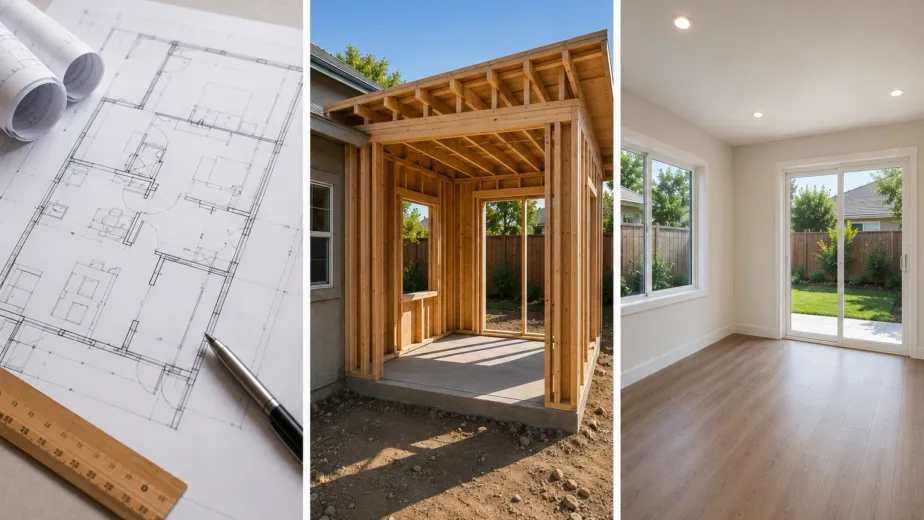


Unpermitted work does not automatically make a California home impossible to sell — but it can quietly erase the value you expected that remodel to create. A converted garage, added bedroom, expanded kitchen, enclosed patio, new bathroom, or structural change may look finished while still raising questions about legality, safety, appraisal, disclosure, and future repair costs. That is why unpermitted work resale value California is really a marketability issue as much as a code issue: buyers want to know whether the space they are paying for was approved, inspected, and built to the standards that applied when the work was done. Lenders and appraisers may also need to judge how an unpermitted addition affects the property’s value.
This guide explains why missing permits hurt resale, how California disclosure and appraisal rules treat them, and what Rancho Cucamonga homeowners can do before listing.
Why Does Unpermitted Work Hurt Resale Value?
The problem is uncertainty. A permitted remodel gives a future buyer a paper trail. An unpermitted remodel leaves unanswered questions: Was the wiring inspected? Was a structural wall altered correctly? Does the new bedroom meet applicable requirements? Was plumbing added legally? Can the city require corrections? Will the lender or appraiser treat the added space the same way as permitted space?
Those questions do not guarantee a lower sale price, but they can reduce buyer confidence, trigger negotiation or corrections, and delay closing. California’s current Transfer Disclosure Statement specifically asks about alterations made without necessary permits and work not in compliance with building codes. Working with a contractor who pulls permits correctly the first time — see what to know before hiring a renovation company — is the simplest way to avoid the problem entirely.
1. Disclosure Forms Expose Unpermitted Work to Buyers
When you sell a typical California residential property subject to the Transfer Disclosure Statement, permit history is not just a private issue between you and the city. It can become part of the buyer’s disclosure package.
The California Department of Real Estate Transfer Disclosure Statement asks whether the seller is aware of additions, structural modifications, alterations, or repairs made without necessary permits or not in compliance with building codes.
California law also adds disclosure duties in certain short-term resales. For qualifying single-family homes resold within 18 months after acquisition, Civil Code Section 1102.6h requires disclosure of specified contractor-performed work and permit copies when applicable. Covering the drywall does not erase the permit question.
2. Appraisers Must Address an Unpermitted Addition
One of the biggest unpermitted remodel problems is assuming every finished square foot will automatically receive the same valuation treatment as clearly permitted living space.
Fannie Mae’s current appraisal guidance says that when an appraiser identifies an addition without the required permit, the appraiser must comment on the quality and appearance of the work and assess its impact, if any, on the property’s market value.
You can review the rule in Fannie Mae’s guidance on additions without permits. This does not mean an unpermitted addition has zero value — the effect is property-specific, and it helps to understand how much value added space actually returns. If the asking price assumes a premium the appraisal will not support, the expected resale gain can shrink.
3. Missing Permits Become a Buyer’s Repair Worry
Without approved plans and inspection history, buyers may question electrical, plumbing, framing, waterproofing, or structural work. A cautious buyer may request inspections, a price reduction, corrections, or choose another home with cleaner documentation. The cost can therefore appear as repair credits, delays, or a weaker offer — not only city fees.
4. Unpermitted Work Can Complicate a Buyer’s Financing
Financing is one of the clearest ways unpermitted work resale value California turns into a transaction problem. A lender’s response depends on the loan program, appraisal, property condition, and specific improvement; unpermitted work is not automatically unfinanceable. But underwriting questions can arise when legal use is unclear or the work creates safety, structural, zoning, or marketability concerns. Fannie Mae requires appraisers to address unpermitted additions, and serious deficiencies can trigger repair or professional-inspection requirements.
5. Rancho Cucamonga Permit Records Buyers Can Check
Rancho Cucamonga’s public records portal provides Building & Safety permit details from 2001 to the present. The City also reviews residential additions and remodeling and inspects permitted work. See the Rancho Cucamonga Building & Safety page. A buyer or professional can compare visible improvements with available permit history.
Understanding how long approvals normally take — the California permit timeline — also helps you judge whether legalizing older work is realistic before a sale.
6. The City Can Force Corrections on Unpermitted Additions
Another reason unpermitted work resale value California can become a problem is that legalization may involve more than paying a missed permit fee.
Rancho Cucamonga requires permits for structural alterations, and its Building & Safety resources include remediation guidance for unpermitted building conversions. Depending on the work, correction can require plans, professional evaluation, opening finished areas, upgrades, repairs, or removal — costs that are easier to weigh against typical home renovation costs in San Bernardino. Ask Building & Safety what is required for the specific address.
7. Legalizing Unpermitted Work Often Costs More Later
Skipping permits does not necessarily save money forever. Legalization may require opening finished areas, structural calculations, trade corrections, or code upgrades before approval. Review WM Construction’s San Bernardino County home remodeling permit requirements before work begins.
8. Selling Unpermitted Work As Is Still Needs Disclosure
Some sellers assume selling home unpermitted work concerns disappear with an “as is” listing. They do not. “As is” can affect repair negotiations, but it does not replace required California disclosures. If you know work lacked necessary permits, discuss the disclosure with a qualified real estate professional or attorney.
How to Confirm Whether Your Remodel Was Permitted
Before listing, compare the property with available permit history and your records.
- Search the City’s Building & Safety permit records.
- Look for your permit card, approved plans, inspection results, and final approval documents.
- Compare the permitted scope with what was actually built.
- Check additions, converted garages, bathrooms, electrical upgrades, structural wall changes, and major plumbing work carefully.
- If the records do not match the house, contact Rancho Cucamonga Building & Safety before assuming the work is legal.
If you are planning a new project instead, WM Construction’s Inland Empire home renovation checklist can help you organize design, scope, permits, and construction before demolition begins.
What to Do About Existing Unpermitted Work
- Document what exists. Gather contracts, drawings, receipts, photos, and contractor information.
- Check the permit record. Confirm whether a permit exists under a different project description or permit number.
- Ask the city about correction. Requirements depend on the work and current condition.
- Get professional help where needed. Structural and trade work may require qualified professionals.
- Resolve what you reasonably can before listing. A completed permit record is easier to explain than an unresolved violation or unknown condition.
For future work, read WM Construction’s guide on choosing a remodeling contractor in Rancho Cucamonga and put permit responsibility in writing.
How WM Construction Handles Remodeling Permits
With over 10 years of experience, we’ve been remodeling homes in Rancho Cucamonga and Ontario since 2014 — more than a decade of real work, one home at a time.
Customer satisfaction is our #1 priority. Every project we finish comes with a signed client form, and we’ve completed 127+ home remodels since 2014. We get the job done right.
WM Construction is licensed by the California State License Board — License 1104199. For ADUs and additions, the site states that WM Construction assists clients through third parties with engineering, plans, city submittal and follow-ups, HOA coordination, and pulling permits. Permit responsibility should also be clear in the signed contract.
WM Construction’s project process also includes:
- A free 3D Design before you pay a dime
- Weekly photo and video updates — so you always know what’s happening
- A written contract — no hidden changes, no surprises
- A homeowner-focused completion process — we don’t say the project is done until the agreed work has been addressed
See completed work in the WM Construction project gallery, learn more about WM Construction, or explore home remodeling services for your next project.
Unpermitted Work Resale Value California FAQ
Can I sell a house with unpermitted work in California?
Yes, in many situations, but disclosure, appraisal, lending, city, and repair issues may affect the transaction. Do not assume “as is” removes California disclosure duties.
Does unpermitted square footage have zero value?
Not automatically. Fannie Mae requires the appraiser to assess the work and its effect, if any, on market value. Contributory value is property- and market-specific.
I want to remodel my kitchen — what’s the first step?
We come to your home for a free meeting. We review what you want, measure the space, discuss the 3D Design and project scope, and build it according to the approved plan. For local planning, review WM Construction’s Rancho Cucamonga kitchen remodeling process.
Can you help me build an ADU on my property?
Yes. We specialize in ADUs in Rancho Cucamonga and Ontario — from the first sketch to the final inspection. We help coordinate the plan, city process, and construction. Start with the Rancho Cucamonga ADU regulations guide.
How long does a full home remodel take?
Most projects take 8 to 12 weeks, depending on scope, permits, inspections, material selections, and site conditions. You won’t be left wondering what’s happening because the project process includes regular updates.
What makes you different from other contractors?
We don’t disappear after you pay. WM Construction uses a written contract, free 3D Design, and weekly photo and video updates. We don’t say “it’s done” until you say it’s right.
I’m scared to pay upfront — what if you disappear?
We start with a written contract — every detail is there. WM Construction’s website lists California State License Board License 1104199, and the project process includes documented updates and permit coordination where required by the agreed scope.
Why Permits Protect Your Home’s Resale Value
The safest lesson about unpermitted work resale value California is that permits are not paperwork you worry about only during construction. They become part of the home’s history.
When work is properly planned, permitted, inspected, and documented, a future buyer can see what was approved. When it is not, the seller may have to answer difficult questions about disclosure, appraisal, corrections, and value at the worst possible time — while trying to close a sale.
Book a consult — we pull all required project permits. Call +1 951-310-3458 or schedule a free consultation with WM Construction for a permitted home remodeling, ADU, kitchen, bathroom, or home addition project in Rancho Cucamonga or the Inland Empire.